
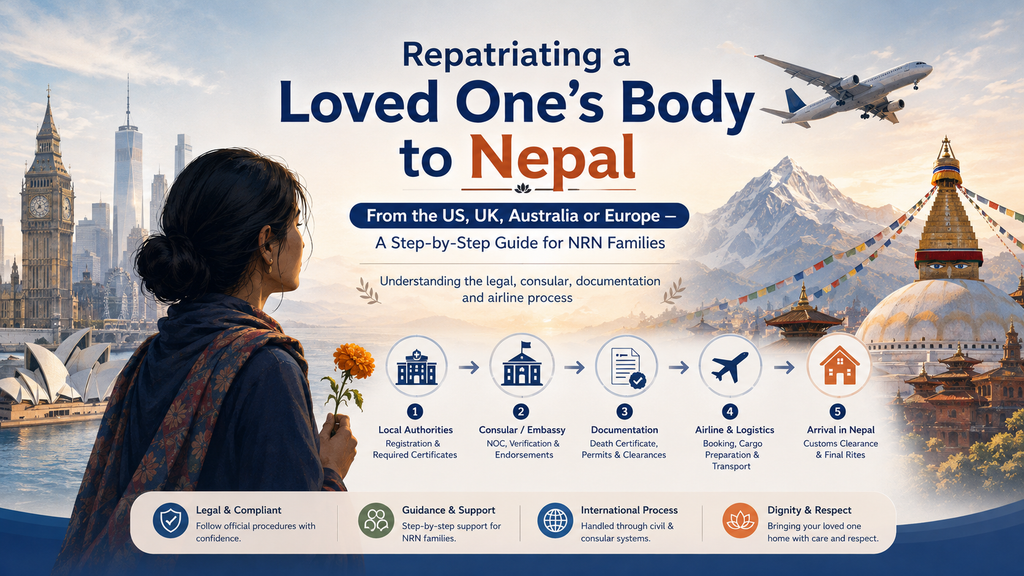
Losing a family member abroad is difficult enough without also having to figure out an unfamiliar legal process in a country you may not know well. If you’re a Non-Resident Nepali (NRN), student, or professional living in the US, UK, Australia, Europe, or Canada, and you now need to bring a loved one’s body home to Nepal, this guide walks through exactly what’s involved — so you know what to expect at each stage.
This process is meaningfully different from repatriation for Nepali migrant workers in the Gulf. There’s no Foreign Employment Board involvement, no employer or sponsor coordinating on your behalf, and the legal steps run through the host country’s civil and consular systems instead. Here’s what that actually looks like.
Step-by-Step: What Happens After a Death Abroad
1. Register the Death Locally
Before anything else can move forward, the death must be formally registered with the relevant civil authority — the Registry of Births, Deaths and Marriages in the UK or Australia, the county/state vital records office in the US, or the equivalent civil registrar in most of Europe. This produces the official death certificate, which every later step depends on.
In most countries, standard registration takes two to three weeks — but funeral homes handling a repatriation case can usually get this expedited to within 24–48 hours when they flag it as a repatriation from the outset.
2. Coroner Involvement, If Required
If the death was sudden, accidental, unexplained, or occurred outside a hospital or under medical care, a coroner (or medical examiner, depending on the country) may need to investigate before releasing the body. In the UK, this results in a Coroner’s “Out of England” certificate, which is required before the body can leave the country. This is the single biggest source of delay in repatriation cases — investigations can take anywhere from a few days to several weeks depending on the circumstances.
3. Appoint a Local Funeral Home
Unlike Gulf cases where the employer or sponsor often initiates the process, families abroad typically need to select and appoint a licensed funeral home in the country of death. The funeral home:
- Handles embalming and prepares the body in a sealed, international-transport-compliant casket
- Coordinates with a receiving mortuary service provider in Nepal
- Assembles and submits the documentation package to the airline and Nepali embassy
- Books the freight/cargo flight and produces the airway bill
Most established funeral homes have handled international repatriations before — it’s worth explicitly asking whether they have experience specifically with Nepal, since document requirements (particularly embassy NOC and legalization) differ from country to country.
4. Nepali Embassy or Consulate: No Objection Certificate (NOC)
As with Gulf cases, the Nepali embassy or consulate nearest to the place of death must issue a No Objection Certificate (NOC) before the body can be repatriated. To apply, the next of kin (or the appointed funeral home on their behalf) typically submits:
- An application letter from the next of kin, with contact details of the receiving person in Nepal
- Copy of the deceased’s passport and/or citizenship certificate
- Local death certificate
- Coroner’s release/certificate, if one was required
Important for Western countries specifically: documents often need to be apostilled or go through country-specific legalization before the embassy will accept them — for example, FCDO (Foreign, Commonwealth & Development Office) legalization in the UK. This step is frequently missed by families unfamiliar with the process and can add days to the timeline if not handled upfront.
5. Document Package for Transport
By the time the body is ready to fly, the funeral home will have assembled:
- Local death certificate
- Embalming certificate
- Freedom-from-infection certificate
- Nepali embassy NOC
- Passport copy of the deceased
- Airway bill from the airline
6. Receiving End in Nepal
A family member or a designated coordinator needs to be present at Tribhuvan International Airport to complete customs clearance and arrange onward transport to the family’s home region. Nepal-side coordination — confirming flight details, tracking the shipment, and being ready at arrival — is where many families abroad find it hardest to stay on top of things from a distance, which is often where a local coordinator becomes valuable.
How Long Does It Take?
| Scenario | Typical Timeline |
|---|---|
| Straightforward case, no coroner involvement | 5–10 working days after documentation is released |
| Coroner investigation required | 2–6 weeks, depending on the country and case complexity |
| Documents requiring apostille/legalization delays | Add 3–7 additional days |
What Does It Cost?
Repatriation costs from Western countries are generally higher than from the Gulf, largely due to funeral home fees, longer flight distances, and destination-country administrative charges:
- United Kingdom: Roughly £1,800–£2,800, plus flight/freight costs, depending on departure location and funeral home
- Australia: Typically mid-AUD $6,000–$7,000 all-inclusive (coffin, funeral director’s fee, health department fee, freight, and logistics)
- United States: Costs vary significantly by state and funeral home, but generally fall in a comparable range once embalming, casket, and international freight are included
- Europe: Similar range to the UK, with variation based on the specific country’s registration and legalization requirements
Check your insurance first. Many NRNs and international students hold health, travel, or life insurance policies that include repatriation of remains as a benefit — this is worth checking immediately, as it can significantly reduce or eliminate the family’s out-of-pocket cost. Unlike Gulf labor migration cases, there is no equivalent to Nepal’s Foreign Employment Board compensation for NRNs, students, or professionals, so insurance coverage is often the only source of financial support available.
Does the Nepali embassy cover any of the cost?
No — the embassy’s role is to issue the No Objection Certificate and provide consular assistance (such as unofficial document translations), not to fund repatriation. Some embassies can act as a liaison if the family has no one available to coordinate locally, but the costs themselves remain the family’s responsibility unless covered by insurance.
What if there’s no one in Nepal to receive the body?
The embassy or a hired local coordinator can help arrange receiving-end logistics, but having a specific point of contact and address in Nepal is required as part of the documentation process, so this should be arranged before the body departs.
Can the process be done without a coroner’s involvement?
Only if the death was under existing medical care or otherwise doesn’t meet the threshold requiring investigation — this is determined by local authorities, not the family, and varies by jurisdiction.
How is this different from repatriating a migrant worker’s body from the Gulf?
The core steps (documentation, embalming, embassy NOC, airline coordination) are similar, but Gulf cases often involve the employer/sponsor and, for workers with valid permits, potential compensation through Nepal’s Foreign Employment Board. NRN and professional/student cases in Western countries run entirely through civil registration, coroner systems (if applicable), and family-appointed funeral homes, with no equivalent compensation scheme. Read our guide on Gulf and Malaysia repatriation here.
Let Us Coordinate the Nepal Side
While the funeral home abroad manages documentation and transport from their end, having a dedicated coordinator in Nepal to track the shipment, manage embassy communication, and handle receiving-end logistics at Tribhuvan International Airport takes a significant burden off a grieving family. Key Health Assist provides exactly this — a single 24/7 point of contact on the Nepal side, so you’re not managing two countries’ worth of coordination alone.
24/7 Helpline: +977 9715133444 WhatsApp: wa.me/9779715133444
Learn more about our Dead Body Repatriation service.