
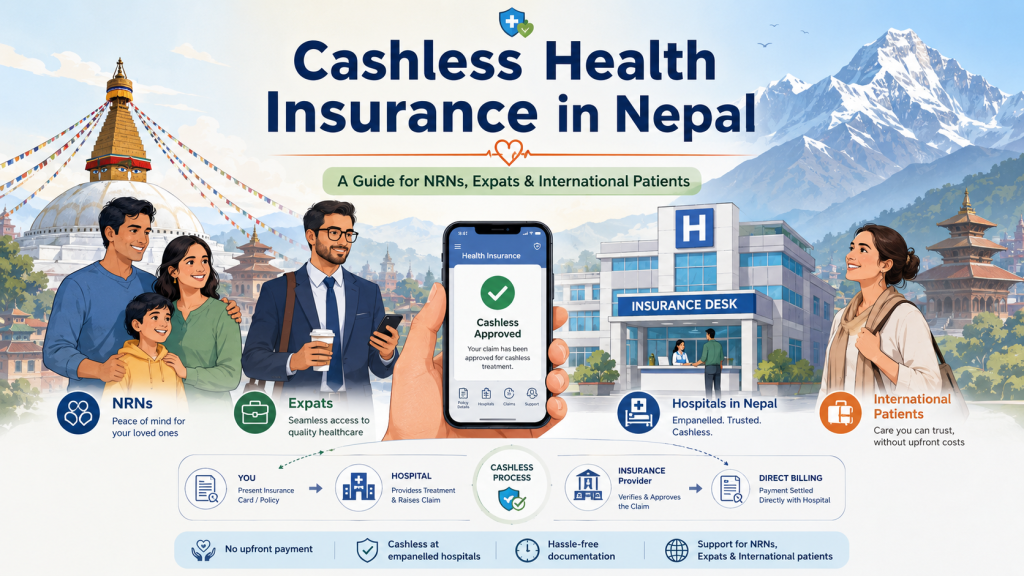
If you’re a Non-Resident Nepali coming home for treatment, an expat living in Kathmandu, or an international patient planning care in Nepal, one question comes up almost every time: “Will my insurance actually cover this, or am I paying out of pocket and hoping for reimbursement later?”
It’s a fair question, and the honest answer is: it depends — on your insurer, the hospital, and whether the right paperwork gets filed at the right time. This guide walks through exactly how cashless insurance and TPA coordination work in Nepal, so you know what to expect before you’re standing at a hospital admissions desk.
What “Cashless” Actually Means
Cashless hospitalization means the hospital bills your insurance company (or its representative) directly, so you don’t pay the full amount upfront and wait for reimbursement. Instead of settling the bill yourself and filing a claim afterward, the hospital’s insurance desk handles the paperwork with your insurer while you focus on treatment.
This only works, though, if:
- The hospital is part of your insurer’s network (called an empanelled or network hospital)
- Your policy actually covers the treatment you need
- The required pre-authorization is submitted and approved before or shortly after admission
Miss any one of these, and you may be back to paying upfront and claiming reimbursement — which is why understanding the process in advance matters so much.
Who Handles the Claim: The Role of a TPA
A Third Party Administrator (TPA) is the organization that sits between your insurance company and the hospital. The insurer doesn’t process claims itself in most cases — it appoints a TPA to verify your policy, review the treatment being requested, and approve or deny cashless access based on your policy’s terms.
The hospital’s TPA desk is your first stop for anything insurance-related during a hospital stay. Their role is administrative, not medical — they can’t approve or deny your treatment, only whether it’s billed cashless or requires reimbursement.
The Cashless Process, Step by Step
1. Planned (Non-Emergency) Treatment
- Contact the hospital’s TPA/insurance desk at least 2–3 days before admission
- Provide your insurance card or policy number, ID document, and doctor’s referral or treatment plan
- The hospital submits a pre-authorization request to your TPA on your behalf
- The TPA reviews the request against your policy terms and issues an approval, denial, or request for more information
- Once approved, you’re admitted and treated without paying the covered portion upfront
2. Emergency Admission
- Emergency cases are typically admitted first, with insurance intimation happening within 24 hours of admission
- The hospital’s TPA desk still submits paperwork retroactively, but treatment isn’t held up waiting for approval
- If cashless approval is later denied, you’re not denied treatment — you simply become responsible for the bill and can pursue reimbursement separately
3. Discharge
- Final bills, discharge summary, and any non-covered charges are settled at this stage
- Keep copies of every document handed to you — many delayed reimbursement claims trace back to a missing bill or report
What NRNs and International Patients Should Know Specifically
If your insurance policy was issued outside Nepal — in the UAE, Qatar, the UK, or elsewhere — a few extra considerations apply:
Confirm network status before you travel, not after. Many foreign insurers don’t have direct tie-ups with Nepali hospitals, meaning “cashless” in your home country’s policy language may not translate to cashless in Nepal. In many cases, international patients pay the hospital directly and file for reimbursement once they’re back home or once documents are couriered to their insurer.
Ask specifically about direct billing arrangements. Some international insurers and corporate group policies do have direct billing agreements with major Kathmandu hospitals. It’s worth confirming this by name with both your insurer and the hospital’s international patient desk before assuming either way.
Currency and documentation matter more across borders. Bills, prescriptions, and diagnostic reports may need to be translated or notarized depending on your insurer’s home-country requirements. Sorting this at the point of discharge — rather than weeks later from abroad — saves significant delay.
A local coordinator can bridge the gap. Because so much of this depends on direct communication between a foreign insurer and a Nepali hospital’s billing office, having someone in Nepal actively coordinating both sides — rather than each side waiting on the other — is often the difference between a claim settled in days versus one stuck for months.
Common Reasons Cashless Claims Get Delayed or Denied
- Incomplete or mismatched documents — names, policy numbers, or dates that don’t match across forms
- Treatment not covered under the specific policy (common with certain elective procedures or pre-existing conditions)
- Hospital not empanelled with that particular insurer or TPA
- Late intimation — planned treatments reported to the TPA too close to or after admission
- Missing pre-authorization for planned procedures, especially surgeries scheduled with limited notice
Denial of cashless approval does not mean denial of treatment — it means you’ll need to pay and claim reimbursement instead. Hospitals are obligated to treat you regardless of the insurance outcome.
Reimbursement Claims: What to Keep
If cashless isn’t available or is denied, you’ll need to file for reimbursement. Keep these ready:
- Original itemized hospital bills and receipts
- Discharge summary and treatment records
- Diagnostic reports and prescriptions
- Payment receipts (bank transfer records, card slips)
- A copy of your policy document and ID
Reimbursement claims in Nepal are typically processed within 15–30 days for straightforward cases, and 45–60 days for more complex ones requiring additional verification.
Frequently Asked Questions
Is cashless treatment available at all hospitals in Nepal?
No — only hospitals empanelled with your specific insurer or TPA offer cashless billing. It’s worth confirming your hospital’s network status with your insurer before admission, especially for planned treatment.
Does my foreign insurance policy work as cashless in Nepal?
Not always. Many international policies don’t have direct billing agreements with Nepali hospitals, meaning you may need to pay upfront and file for reimbursement once documentation is submitted to your insurer.
How long does a pre-authorization approval take?
For planned treatment submitted 2–3 days in advance, approvals are often issued within 24–48 hours. Emergency cases are treated immediately, with paperwork processed alongside or shortly after admission.
What happens if my cashless claim is denied?
You are still treated — denial only means you’ll need to settle the bill directly and submit it for reimbursement afterward, rather than having it billed to your insurer at the point of care.
Can someone help coordinate this on my behalf if I’m not in Nepal?
Yes. A local coordinator can liaise directly with both the hospital’s TPA desk and your foreign insurer, track documentation, and follow up on approvals — which is particularly useful when time zones and paperwork requirements differ between countries.
Let Us Handle the Insurance Coordination
Navigating cashless approvals, TPA paperwork, and cross-border insurance requirements shouldn’t add stress to an already difficult time. Key Health Assist coordinates directly with Nepal’s major hospital networks and insurers to manage pre-authorization, documentation, and claims — so you can focus on the treatment itself.
24/7 Helpline: +977 9715133444 WhatsApp: wa.me/9779715133444
Learn more about our Insurance & TPA Services.