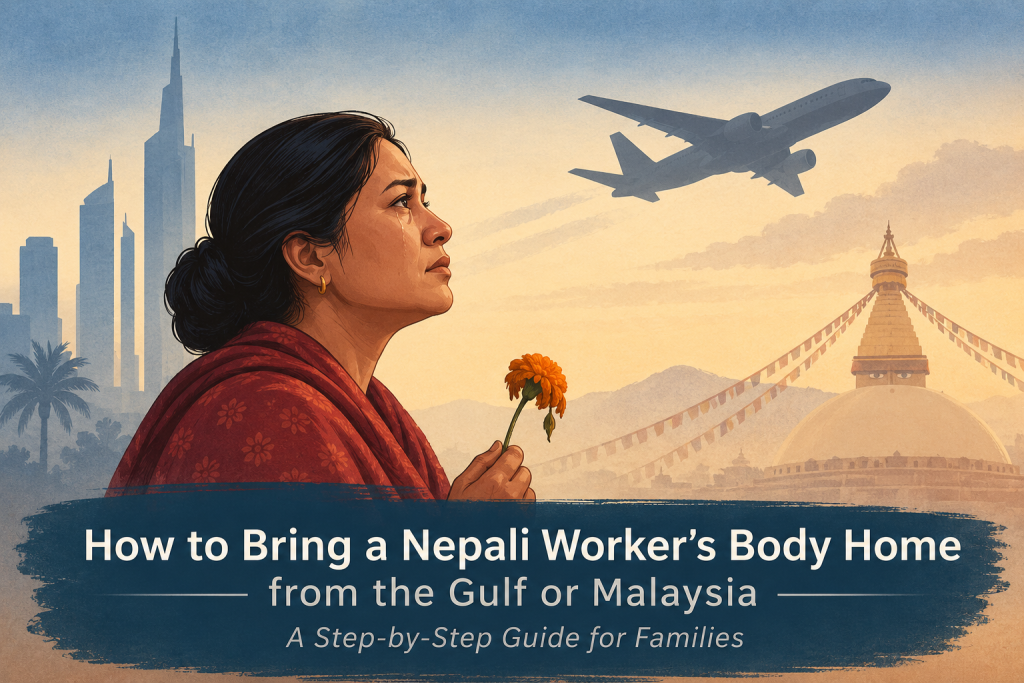
Every year, thousands of Nepali families receive the call no one is prepared for — a son, daughter, husband, or wife working in Qatar, Saudi Arabia, the UAE, or Malaysia has passed away. In the middle of this grief, families are suddenly expected to navigate an unfamiliar system of embassies, employers, police reports, and airline cargo bookings, often with no idea where to even begin.
This guide walks you through exactly what happens, what documents are needed, how long it takes, and what support is legally available — so you can focus on your family instead of the paperwork.
Why This Process Feels So Overwhelming
Nepal sends more than a million workers abroad, and a significant number of families each year face the reality of bringing a loved one’s body home rather than welcoming them back. The process involves at least three different systems working together: the host country’s police and health authorities, the Nepali embassy in that country, and the airline handling the cargo shipment. If the worker was undocumented, worked without a valid permit, or died under unclear circumstances, the process becomes considerably more complicated and can stretch on for weeks.
Understanding the process in advance — even if you’re reading this in the middle of a crisis — makes it far easier to know what to ask for and what to expect.
Step-by-Step: What Happens After a Death Abroad
1. Reporting and Initial Documentation
The employer, sponsor, or a family member in the host country must report the death to the local police, who will typically require a post-mortem or medical examination before releasing the body. This produces the two foundational documents everyone downstream will ask for:
- Local death certificate (issued by the host country’s civil authority or hospital)
- Police report, especially if the death was sudden, unexplained, or accidental
2. Notifying the Nepali Embassy or Consulate
The Nepali embassy in the country where the death occurred needs to be informed as soon as possible. The embassy plays a central coordinating role — it liaises with local authorities, verifies the worker’s documents, and eventually issues the No Objection Certificate (NOC), which is required before a body can legally be shipped out of the country.
If the worker was on a valid, registered labour permit, this step is usually straightforward. If the worker was undocumented or the permit had lapsed, the embassy process takes longer and may require additional verification from the Department of Foreign Employment (DoFE) back in Nepal.
3. Family Consent
Airlines will not accept human remains for transport without written consent from the next of kin. If you’re the family member in Nepal, you (or a designated representative) will need to formally confirm receipt and provide consent documentation — this is often the step that causes delays if families are unaware they need to act quickly.
4. Embalming and Coffin Preparation
Before the body can be flown, it must be embalmed and placed in an airline-approved, sealed, zinc- or lead-lined coffin that meets international aviation transport standards. This is done at a licensed mortuary or hospital in the host country, and an embalming certificate is issued as part of the documentation package.
5. Airline Cargo Booking and Clearance
Once documentation is complete, the remains are booked as air cargo. This requires:
- Airway bill
- Death certificate (translated/attested if required)
- Embalming certificate
- NOC from the embassy
- Passport copy of the deceased
6. Arrival and Receiving-End Coordination
On arrival in Kathmandu (Tribhuvan International Airport handles nearly all repatriations to Nepal), the family or a coordinator needs to be present to receive the coffin, complete customs formalities, and arrange ground transport to the family’s home region for final rites.
How Long Does It Take?
| Scenario | Typical Timeline |
|---|---|
| Valid work permit, straightforward case | 5–10 working days |
| Undocumented worker or lapsed permit | 3–6 weeks or longer |
| Death under investigation (accident, unclear cause) | Can extend to several months |
Delays are almost always caused by one of three things: missing family consent documents, unresolved legal status of the worker, or a pending police investigation in the host country.
What Does It Cost?
Costs vary significantly by destination and circumstances:
- Qatar, UAE, Saudi Arabia, Kuwait, Oman, Bahrain: Typically covers embalming, coffin, mortuary storage, documentation, and air cargo charges. Costs can run into the equivalent of several hundred thousand Nepali rupees if not covered by the employer or government support.
- Malaysia: Similar cost structure, with added complexity around distance and flight availability.
Important: If the worker held a valid labour permit and died within the eligible period, the family may qualify for compensation and dead body management support through Nepal’s Foreign Employment Board, which is meant to substantially reduce or eliminate the family’s out-of-pocket cost. Many families are unaware this support exists or don’t know how to apply — this is one of the most valuable things a coordinator can help you access quickly.
What If the Worker Was Undocumented or Had No Valid Permit?
This is one of the most difficult situations families face. Without a valid labour permit, the Foreign Employment Board’s compensation and repatriation cost support typically does not apply, and the family may be responsible for the full cost, sometimes with added delays for legal clearance in the host country. In these cases:
- The Nepali embassy can still assist with documentation and NOC issuance, but timelines are longer.
- Community organizations, migrant worker rights groups, and in some cases the recruitment agency (if one was involved) may be able to contribute or negotiate on the family’s behalf.
- Having someone experienced navigate embassy and airline coordination becomes even more important, since there’s no automatic government process to fall back on.
Documents Families in Nepal Should Prepare
While most documentation is generated in the host country, families in Nepal are usually asked for:
- Citizenship certificate of the deceased and next of kin
- Relationship/kinship certificate (nata pramanpatra) if required by the embassy
- Passport copy and visa copy of the deceased (if available)
- Bank details for compensation disbursement, if applicable
- A local contact person and address for receiving-end coordination
Having these ready in advance — even before the body departs the host country — can shave days off the process.
How a Coordinator Helps
Because this process spans two countries, multiple government offices, an airline, and a grieving family with little time or capacity to make dozens of calls, having a single point of contact matters enormously. A dedicated coordinator can:
- Communicate directly with the embassy and mortuary in the host country
- Track and consolidate documentation as it’s issued
- Manage airline cargo booking and flight tracking
- Coordinate the receiving end at Kathmandu airport and onward transport
- Help families understand and apply for Foreign Employment Board compensation where eligible
This is exactly the kind of coordination Key Health Assist’s dead body repatriation service provides — a single 24/7 point of contact so families aren’t left calling multiple offices while grieving.
Frequently Asked Questions
How long does it take to bring a body from Qatar or the UAE to Nepal? For workers with valid permits and complete documentation, repatriation typically takes 5–10 working days. Cases involving legal complications or missing documentation can take considerably longer.
Is government compensation available for the family? Families of workers who died while holding a valid labour permit, within the eligible period, may qualify for compensation and dead body repatriation support through Nepal’s Foreign Employment Board. Eligibility depends on the worker’s documented status at the time of death.
What if the worker didn’t have a valid work permit? The process is still possible, but government compensation and cost support generally don’t apply. The family may need to cover costs directly, and the process usually takes longer due to additional legal clearance requirements.
What documents does the family in Nepal need to provide? Typically a citizenship certificate, relationship certificate, passport/visa copy of the deceased, and a local contact for receiving-end coordination. The rest of the documentation (death certificate, police report, embalming certificate, embassy NOC) is generated in the host country.
Can religious and cultural rites be accommodated? Yes. Embalming, coffin preparation, and receiving-end arrangements can be coordinated to accommodate Hindu, Buddhist, Muslim, Christian, and other funeral traditions.
In Your Moment of Loss
If you’re facing this process right now, you don’t have to manage it alone. Key Health Assist coordinates dead body repatriation from the Gulf, Malaysia, India, Bangladesh, and beyond — handling documentation, embalming, embassy liaison, and receiving-end support so your family can focus on saying goodbye.
24/7 Helpline: +977 9715133444 WhatsApp: wa.me/9779715133444