
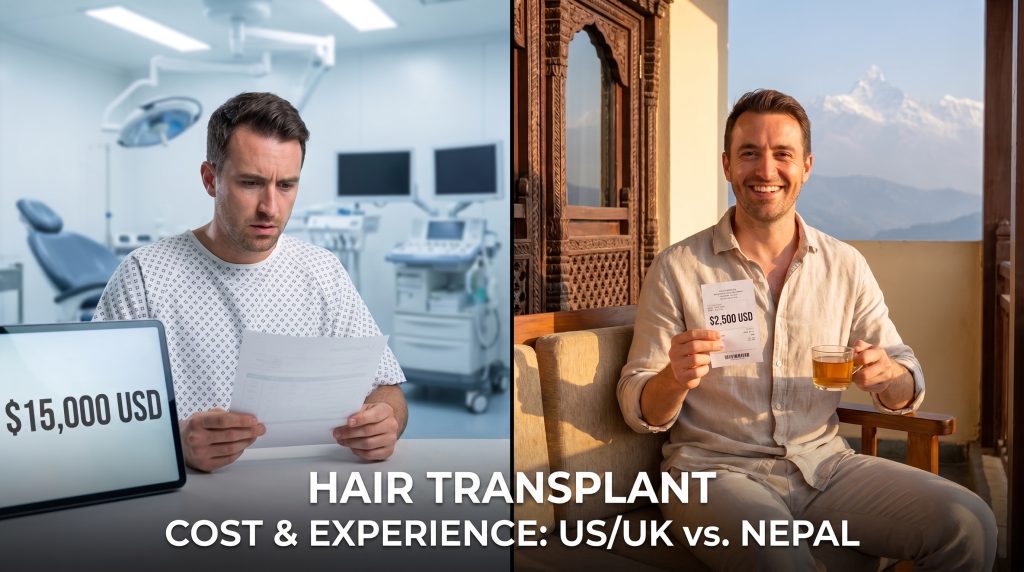
Let’s be honest — if you’re reading this, you’ve probably already spent hours scrolling through before-and-after photos, watching testimonial videos, and doing that thing where you zoom into your own hairline in bad bathroom lighting wondering just how bad it’s gotten. We’ve all been there. And right after the “should I do this” question comes the one that actually keeps people up at night: “How much is this going to cost me — and is it worth flying somewhere else to get it done?”
Good news: you’re asking exactly the right question. Because when it comes to hair transplants, where you get it done can matter almost as much as how it’s done. Let’s break down the real numbers.
The Sticker Shock at Home
If you’ve priced out a hair transplant in the US, UK, or many Gulf countries, you already know the number can be brutal. Depending on the technique and the number of grafts you need, a full hair transplant in these countries typically runs anywhere from $8,000 to $20,000+ USD. Some clinics price per graft — often somewhere between $4 and $10 per graft — and if you’re dealing with significant hair loss, that adds up fast. A patient needing 3,000–4,000 grafts can easily be looking at a bill in the five figures before travel, aftercare products, or a single follow-up visit is even factored in.
And that’s before we talk about wait times. In a lot of home countries, especially where demand is high and specialists are booked out, you might be waiting months just to get a consultation, let alone a surgery date.
What Hair Transplant Actually Costs in Nepal
Here’s where things get interesting. In Nepal, the same procedure — performed using the same modern techniques (FUE, FUT, and increasingly DHI) — typically costs a fraction of that. Most patients traveling to Nepal for a hair transplant end up paying somewhere in the range of $1 to $3 per graft, with full procedures often landing between $1,200 and $3,500 USD depending on graft count and technique.
To put that in perspective: a procedure that might cost you $12,000 back home could realistically run you $2,000–$3,000 in Nepal — using the same surgical approach, similar-grade equipment, and surgeons who are often trained internationally.
Why the gap? It comes down to cost of living, clinic overhead, and currency differences — not corner-cutting on quality. Nepal’s medical clinics have invested heavily in modern equipment and technique training over the last several years specifically because medical tourism has become such a significant part of their patient base.
But Wait — Is Hair Transplant Actually the Same Quality?
This is usually the moment where people get skeptical, and honestly, that’s fair. Nobody wants to save a few thousand dollars only to end up with an uneven hairline or, worse, a botched procedure.
Here’s the truth: quality varies by clinic, not by country. That’s true whether you’re in Los Angeles, London, or Kathmandu. The difference is that in Nepal, your dollar goes so much further that you can typically afford a genuinely well-reviewed, well-equipped clinic with an experienced surgical team — instead of settling for a budget option back home just to make the price work.
The key is doing your homework on the clinic itself: surgeon credentials, technique used, patient reviews, and post-op support. This is exactly the kind of vetting that a coordination service can do for you before you ever book a flight.
The Hidden Costs Nobody Talks About
When people compare prices, they often forget to add in the extras. So let’s do the honest math.
At home, your “final cost” often balloons with consultation fees, pre-op bloodwork, follow-up visits, and sometimes touch-up sessions — all billed separately.
In Nepal, many clinics build pre-op assessments, the procedure, and initial follow-up into one transparent package. Add in flights and a short stay, and here’s the surprising part: even after factoring in travel, most patients still come out significantly ahead financially — often saving 60–80% compared to home-country pricing, even after airfare and accommodation.
And unlike a same-day outpatient procedure at home where you head straight back to your regular routine, a trip to Nepal gives you something else: a few days to actually rest, recover, and decompress in a genuinely beautiful setting instead of rushing back to work the next morning.
What About Recovery?
A hair transplant isn’t an overnight fix — there’s swelling, some redness, and a “take it easy” period of several days. Doing that recovery in a quiet guesthouse with mountain views instead of squeezing it in between work meetings tends to make the whole experience feel less like a medical chore and more like something you actually chose to do for yourself.
Many patients extend their trip by a few extra days specifically for this reason — light sightseeing once cleared by their surgeon, a slower pace, and a mental reset that’s hard to get at home.
Frequently Asked Questions
Is getting a hair transplant in Nepal actually safe?
Yes, as long as you vet the clinic the same way you would anywhere else. Many surgeons in Nepal have trained internationally and use the same FUE, FUT, and DHI techniques you’d find at a top clinic back home. Safety comes down to the specific clinic’s credentials and hygiene standards, not the country itself.
How many grafts will I actually need?
This depends entirely on the size and pattern of your hair loss — most patients need anywhere from 1,500 to 4,000+ grafts. A proper consultation (ideally with photos reviewed in advance) is the only way to get an accurate number, which is also what determines your final price.
What’s usually included in a Nepal hair transplant package?
Most clinics bundle the consultation, the procedure itself, and initial follow-up care into one price. Some also include airport pickup and accommodation assistance for international patients. Always ask for an itemized breakdown before booking so you know exactly what’s covered.
How long do I need to stay in Nepal for the procedure and recovery?
Most patients plan for 4–7 days total — enough time for the procedure, the first round of healing, and a follow-up check before flying home. Extending your stay by a few extra days for rest is common and often recommended.
Will the results look as natural as a procedure done at home?
Results depend on surgeon skill and technique, not geography. A well-reviewed clinic in Nepal using modern FUE/DHI methods can produce results on par with — or better than — a rushed, budget procedure at home.